What to Do If Stuck in Mud: Step-by-Step Recovery
Last Updated: October 23, 2026
Quick Summary
When stuck in mud, stop accelerating immediately and avoid spinning your wheels, which creates a glazed surface that makes escape harder. Instead, use low gear with gentle throttle, rock your vehicle forward and backward, or add traction aids like floor mats under your drive wheels to regain grip and slowly work free.
- Stop wheel spin immediately, as spinning tires glaze the mud surface and dig deeper ruts
- Rock your vehicle by shifting between Drive and Reverse every 2-3 seconds for 5-10 cycles to build momentum
- Place floor mats, cardboard, or wood under drive wheels to increase tire grip and contact area
- Reduce tire pressure to 15-20 PSI as a recovery measure to increase the tire contact patch
- Call professional winch-out recovery if you're not moving after 15-20 minutes to avoid transmission damage
Table of Contents
- Assess Your Situation Before You Act
- Stop Wheel Spin and Avoid Aggressive Acceleration
- How to Get Unstuck in Mud Without Tools
- Traction Aids for a Car Stuck in Mud
- Clear Mud and Create a Path Forward
- Roadside Assistance for a Car Stuck in Mud
- When to Call for Mud Winch-Out Service
- After Recovery: Checks and Prevention
- Frequently Asked Questions
Assess Your Situation Before You Act
When your car sinks into mud, the first instinct is often to floor the accelerator. Don't.
Get out and walk around your vehicle. Check how much of the tire is submerged, whether mud touches the undercarriage, and whether the ground firms up a few feet away.
Also assess the terrain ahead. If you're surrounded by soft mud in every direction, aggressive attempts to escape will only dig you deeper and potentially damage your vehicle.
Safety comes first. Turn on your hazard lights and make yourself visible to other drivers. If traffic is heavy or conditions are dangerous, stay inside with your seatbelt on and call for professional recovery.
Stop Wheel Spin and Avoid Aggressive Acceleration
This is where most people make the situation worse.
Aggressive acceleration heats your tires, reducing grip further, and throws mud onto your undercarriage and suspension. For luxury vehicles or low-clearance sports cars, this can cause thousands of dollars in damage.
Instead, ease off the throttle completely. Take your foot off the gas. Let your wheels stop spinning. This single action prevents you from making the situation dramatically worse.
Once your wheels have stopped, shift into a low gear and try moving forward or backward very slowly. The goal is steady, gentle pressure, not power. Apply just enough throttle to keep the engine engaged without spinning the wheels.
How to Get Unstuck in Mud Without Tools
If you're stuck in mud without specialized recovery equipment, you have three practical options: use low gear and gentle throttle, rock the vehicle forward and backward, or create traction with materials you find nearby.
Use Low Gear and Gentle Throttle
Low gear gives your engine maximum torque at the wheels. In an automatic, use Reverse or Drive depending on direction. In a manual, use Second Gear rather than First, which causes wheelspin more easily.
Apply gentle, steady throttle to build momentum slowly rather than spin the wheels.
If you're not moving after 10-15 seconds of gentle throttle, stop and try a different method. Continuing to apply throttle will only dig you deeper.
Rock the Vehicle Forward and Backward
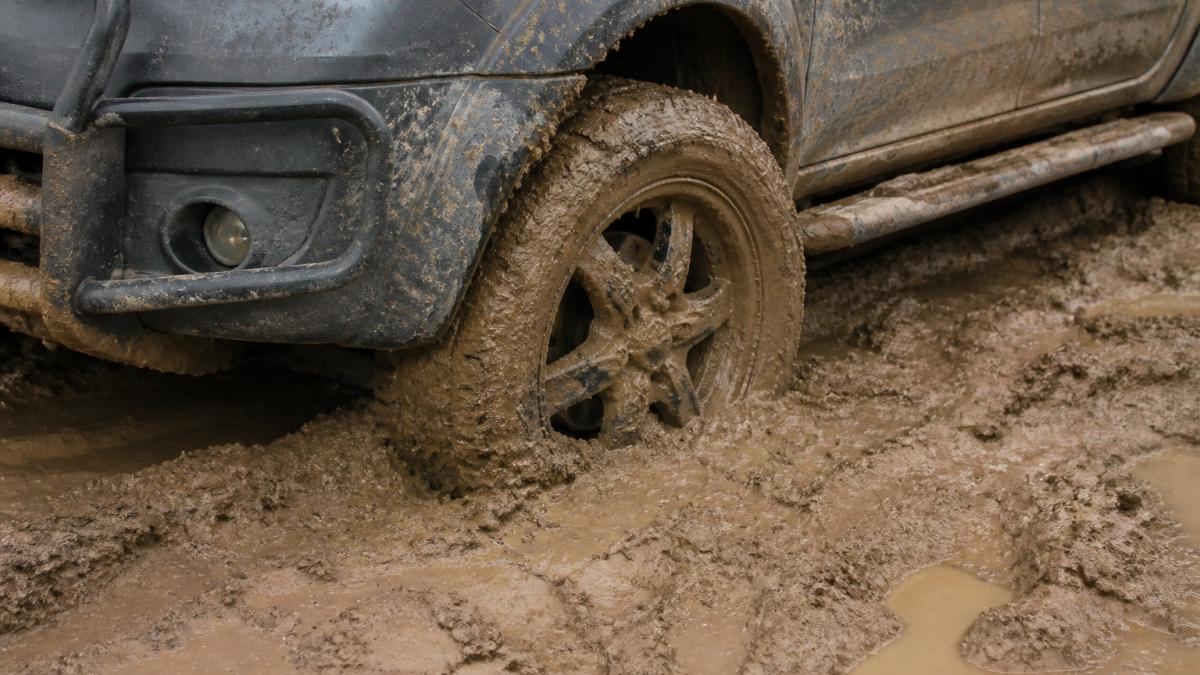
Rocking uses momentum to gradually work your way out.
Start in Drive and accelerate gently for 2-3 seconds, then immediately shift to Reverse and accelerate gently for 2-3 seconds. Repeat 5-10 times, moving a few inches forward overall each cycle.
The key is timing. Shift before your wheels start spinning. If you feel wheelspin, ease off the throttle before shifting. The rhythm matters more than the power.
After 5-10 rocks, pause and assess. Are you making progress toward firmer ground? If yes, continue rocking. If no, stop and add traction aids before trying again.
Traction Aids for a Car Stuck in Mud
When rocking and low-gear driving aren't enough, traction aids create grip by spreading your vehicle's weight over a larger surface area and providing a firmer contact point for your tires.
Materials You Can Use Right Now
You likely have traction aids in your vehicle or nearby without realizing it.
Floor mats or car mats are the most effective improvised option.
Cardboard or wood works if you have it.
Towels, blankets, or burlap can work in a pinch. Layer them under the wheels, the more layers the better.
Kitty litter or sand is less effective than solid materials but better than nothing.
Gravel or small rocks can be gathered and spread under the wheels if you're near a driveway or parking area.
Place your chosen material directly under the drive wheels, the wheels that are powered by your engine.
Reducing Tire Pressure for Better Grip
Lowering your tire pressure increases the contact patch, giving your tire more grip on the mud.
Reduce tire pressure to 15-20 PSI if you're truly stuck, far below the normal 30-35 PSI. Only do this as a recovery measure, not for regular driving.
You'll need a manual tire pump or air compressor to reinflate afterward. If you don't have one, drive slowly to a gas station or call for roadside assistance before driving normally.
Caution: Extremely low tire pressure can damage your tire sidewalls if you drive at normal speeds. After you've escaped the mud, reinflate your tires immediately.
Clear Mud and Create a Path Forward
Sometimes the mud around your tires is so thick your wheels can't grip it at all.
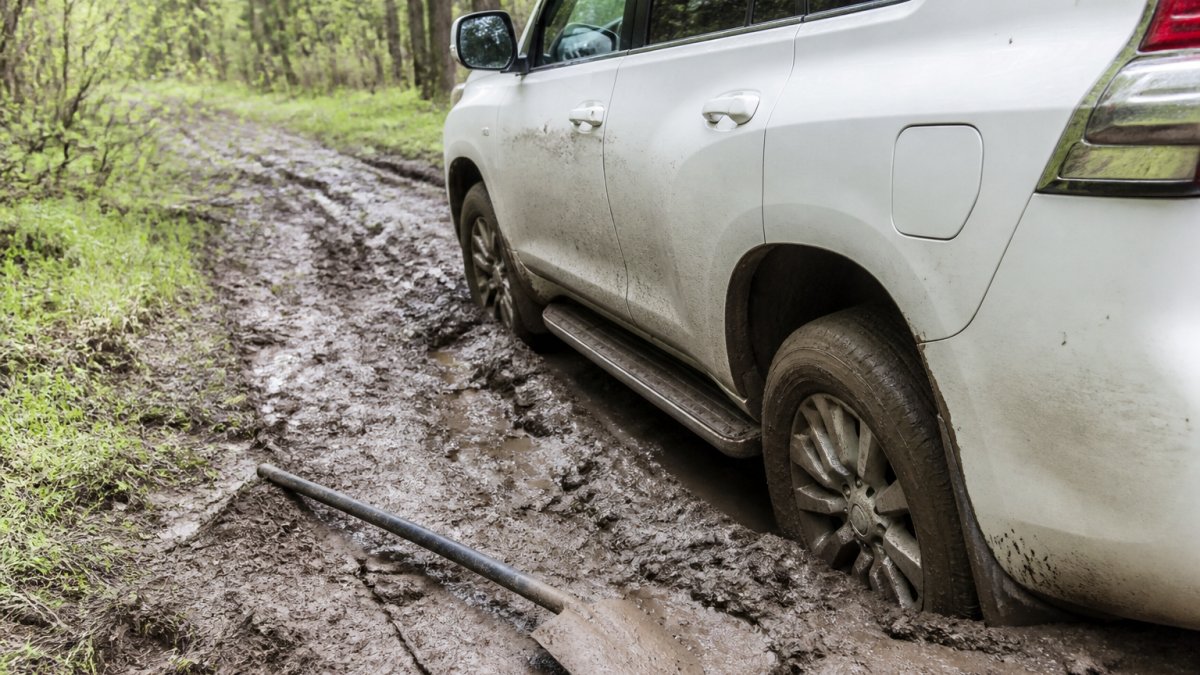
Use a stick, shovel, or tire iron to dig mud away from your drive wheels, focusing on the front and sides of the tires.
Also clear a path forward or backward (whichever direction you're trying to go). Remove large clumps of mud 10-15 feet ahead.
If you have multiple people, this job goes faster. One person can dig while another prepares traction aids or monitors the vehicle.
After clearing, apply your traction aids (mats, cardboard, or sand) to the cleared area. Now try low-gear driving or rocking again.
Roadside Assistance for a Car Stuck in Mud
If you've tried rocking, low-gear driving, and traction aids without success, it's time to call for help. Continuing self-recovery risks damaging your transmission, engine, or undercarriage.
At Kaygold Towing service, we respond 24/7 to drivers stuck in mud throughout the Miami Valley. When you call, you speak directly with the person who will arrive to help, no dispatch center, no subcontractors.
Most roadside assistance services can tow your vehicle out of mud, but not all are equipped for winch-outs. A winch-out uses a powered winch to pull your vehicle straight out, the right tool for truly stuck situations.
When you call for roadside assistance, tell them you're stuck in mud and ask whether they have winch-out capability.
When to Call for Mud Winch-Out Service
Signs It's Time to Stop DIY Attempts
Stop attempting self-recovery if any of these conditions apply:
Your vehicle isn't moving after 15-20 minutes of rocking and traction aids. Continued attempts will only damage your transmission or engine.
Mud is touching your vehicle's undercarriage or chassis. This means you're sinking, not stuck on the surface. Professional recovery is essential.
Your vehicle is tilted or leaning to one side. This indicates uneven sinking and risk of rollover. Do not attempt recovery without professional equipment.
You're on a slope or near a cliff edge. Vehicle recovery on uneven terrain requires professional expertise and equipment.
Your vehicle is in water or near water. Mud combined with standing water creates additional hazards. Call for professional recovery immediately.
You have a luxury vehicle or low-clearance sports car. These vehicles require specialized flatbed transport and careful handling.
What to Expect from Professional Recovery
When a professional recovery service arrives for a winch-out, here's what happens:
The operator assesses the situation and determines the best recovery angle, typically positioning the recovery vehicle at an angle to your stuck vehicle, not directly behind it.
They attach a winch cable or recovery strap to your vehicle's frame, never to bumpers or other parts that can tear off.
The winch pulls your vehicle slowly and steadily out of the mud, typically in 5-15 minutes depending on how deeply you're sunk. Once free, the operator checks for damage before you drive away. The entire process usually takes 20-45 minutes from arrival to completion.
Professional recovery costs vary based on how deeply stuck you are and how far you need to be pulled, but the cost is far less than transmission damage or vehicle damage from continued self-recovery attempts.
After Recovery: Checks and Prevention
Once you're unstuck, don't just drive away.
Check your undercarriage. Look for mud packed into your suspension, brake lines, or other components.
Inspect your tires. Make sure your tire pressure is back to normal (typically 30-35 PSI).
Test your brakes. Drive slowly in a safe area and test them gently.
Have your alignment checked. Being stuck and rocking can put stress on your suspension.
To prevent getting stuck in mud in the future:
Avoid driving on muddy roads after heavy rain. If you must drive on wet or muddy terrain, drive slowly and avoid sudden acceleration or braking.
Check weather forecasts before driving in rural areas. Mud conditions worsen after rain and improve as ground dries.
Keep recovery items in your vehicle: a spare floor mat, a small shovel, jumper cables, and a flashlight.
Tell someone where you're going and when you expect to arrive.
Getting stuck in mud is frustrating, but most situations can be resolved with patience and the right technique. If DIY methods aren't working after 15-20 minutes, professional recovery is the smarter choice.
Frequently Asked Questions
How do I get unstuck in mud by myself without tools?
Start by shifting to low gear (second or third) and applying steady, gentle throttle to avoid wheel spin. Rock the vehicle forward and backward slowly to build momentum. Clear mud from around the tires with your hands or a stick. Use materials you have on hand, floor mats, cardboard, towels, or kitty litter, beneath the drive wheels for traction. If these steps don't work within a few attempts, stop to avoid digging deeper and call for professional recovery to prevent vehicle damage.
What can I put under my tires for traction when stuck in mud?
Traction aids for a car stuck in mud include floor mats, cardboard, towels, blankets, carpet scraps, kitty litter, sand, or small branches. Place these materials in front of and beneath the drive wheels. For better results, layer materials, start with cardboard, then add towels or mats on top. Kitty litter works well because it absorbs moisture and increases grip. Avoid materials that will slip, like plastic or smooth surfaces. Even small household items can provide enough grip to help your wheels find purchase.
When should I call a tow truck for a winch-out?
Call for mud winch-out service if your vehicle is deeply embedded, sinking, or tilted; if you've tried rocking and low-gear techniques without progress; if the mud is thick enough to reach the undercarriage; or if the vehicle is stuck in a location where you risk additional damage or safety hazards. Professional recovery equipment prevents costly damage to your suspension, transmission, and frame. Owner-operated services like Kaygold Towing offer direct communication and honest assessment, call immediately if you're unsure whether DIY attempts are safe.
Will roadside assistance pull my car out of the mud?
Roadside assistance for a car stuck in mud depends on your coverage and the service provider. Standard roadside assistance may offer towing to a mechanic but not winch-out recovery from deep mud. Specialized providers with recovery equipment and experience handle winch-outs safely. Direct communication with your roadside service or a local recovery specialist is essential, confirm they have winch capability and experience with muddy conditions before you're stranded. Owner-operated services can assess your situation and provide honest guidance on whether recovery is possible.
